
#157 The times they are a-changing: what’s your position on the coach's strategy clock?
Coaching often begins as a calling, inspired by service, growth and human connection. Yet for many, it must also become a sustainable livelihood. Passion alone doesn’t pay the bills, and in a crowded marketplace, coaches need to know how to attract clients. Competitive advantage is about choosing a strategy that delivers both impact and income, helping coaches thrive while remaining true to their purpose.
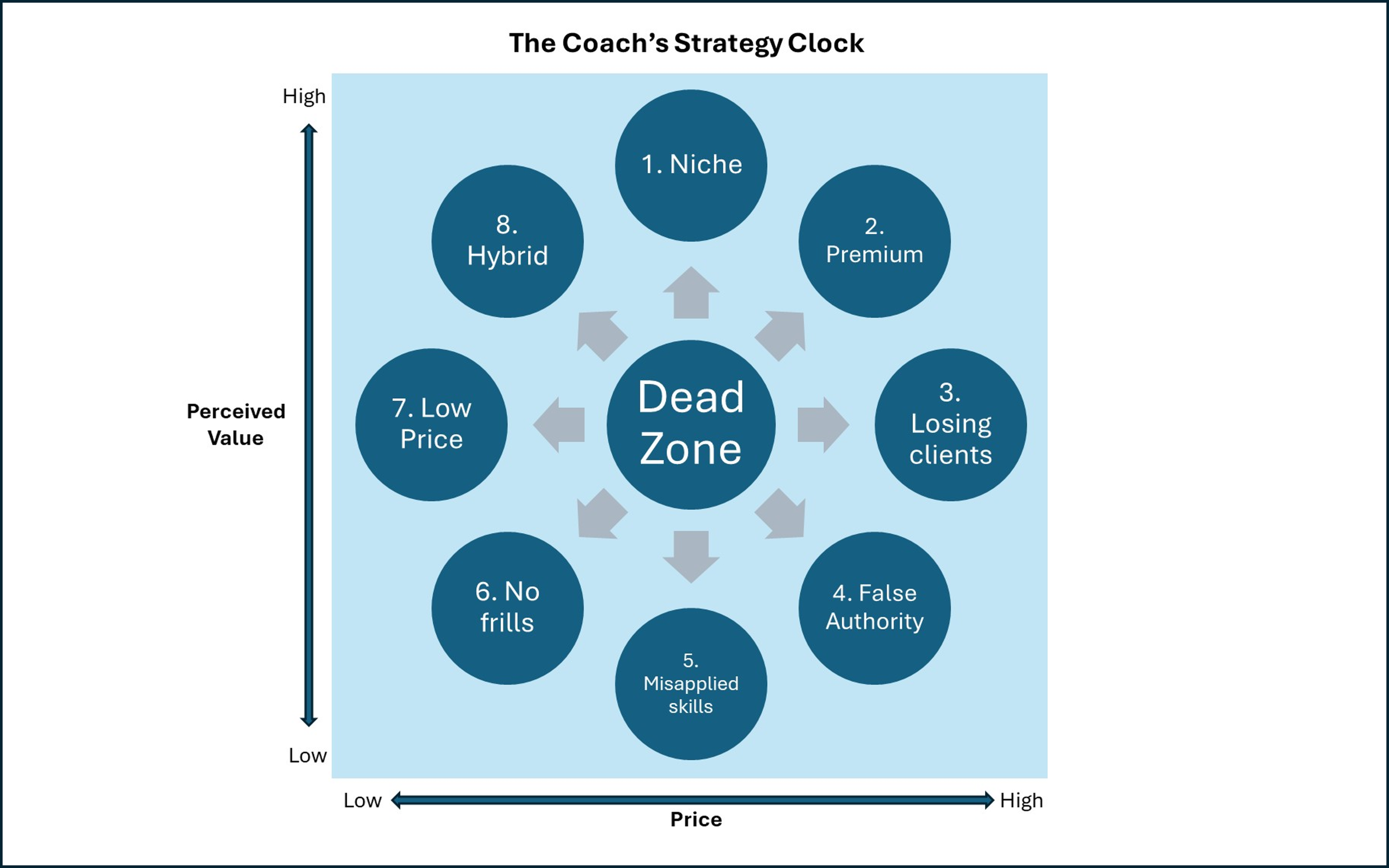
The coach's strategy clock (see picture) is inspired by how businesses think about competitive advantage (see Exploring Corporate Strategy, G. Johnson, K. Scholes & R. Whittington, 2006, Prentice Hall). In a market with many providers of coaching services, prospective clients choose which offering to accept based on their perception of value-for-money, a combination of price and perceived benefit. The eight numbered zones and the central zone represent possible positions for your coaching strategy.
The Dead Zone. (mid-value; mid-price)
‘I’m a coach’ is not a statement of competitive advantage. Why would anyone choose you?
Zone 1: Niche. (high value; mid-price)
‘I’m a coach with a niche’ has become the way to differentiate the value you offer to prospective clients. You have increased your perceived value without increasing your fees.
Zone 2: Premium. (high value; high price)
Here we have ‘focused’ differentiation, where coaches become known for something specific, eg, The Influence Coach, The Menopause Coach. Competitive advantage is maintained through achieving celebrity coaching status, ‘I’m a coaching celebrity’, or is eroded as others enter your niche, although a first-mover advantage may linger longer-term.
Zone 3: Losing clients. (mid-value; high price)
An alternative way to position yourself is to increase your prices, but if you are not offering additional perceived value, you will lose clients. You can inadvertently enter this position from Zone 2 as others enter your niche (ie, your perceived value has dropped), or inadvisedly from the Dead Zone. Either way, ‘I’m an expensive coach’ will not serve you in the long run.
Zone 4: False authority. (low value; high price)
This is another ill-advised strategic position. Offering low value and high prices might win you some clients in the short term, but it is likely to lead to failure. This is a position taken by unqualified and inexperienced coaches, who are good at marketing and believe they can sell a dream. This strategic position screams, ‘I’m a charlatan’. Qualified and experienced coaches can spot them, but unsuspecting potential clients beware.
Zone 5: Misapplied skills (low value; mid-price)
So, you’ve entered the coaching market, but haven’t found your niche yet. You are launching your business and are determined to charge market rate. In principle, you are in the Dead Zone, trying to demonstrate value to move to Zone 1, but if you are misapplying your skills, there is a risk you are presenting yourself as ‘I’m an inexperienced coach’. Do not fear, invest in yourself by engaging in supervision, and we’ll help you raise your value without over-promising or underdelivering.
Zone 6: No frills / Zone 7: Low price (low to mid-value; low price)
Zones 6, 7 and 8 represent the value-for-money positions that prospective clients are looking for. At the low value end, coaching platforms offer human coaches at low price points. Some platforms don’t ask for accreditation by a professional body (no frills), some do (value-for-money). Either way, you are at risk of becoming a faceless coach, ‘I’m one of the coaches on this platform’.
Zone 8: Hybrid (high value; low price)
Many coaches niche while also offering value-for-money. They might be on a platform while also running a private practice. They might coach through associate or employed relationships, while also running their own practice. Sometimes, they offer two niches through different channels, eg, career coaching and leadership development coaching. This hybrid model maintains high perceived value and reasonable pricing, ‘I’m a value-for-money coach with niche(s)’.
The future?
This coach’s strategy clock is all well and good; however, there is a new coaching kid on the block: it’s called AI, and it is fundamentally changing the strategy clock.
AI is creating new positions on the left-hand side of the diagram, beyond Zones 6, 7 and 8, where price lowers even further, for different perceived value positions.
Beyond Zone 7: ‘I’m a coach bot’. (low to mid-value; lower price)
The on-demand coaching platforms paved the way for coach bots. AI coach bots have already been created that can pass muster at PCC level. Why pay for a human coach when you can bypass the platforms completely? There is a strong case that this is not coaching, however, if prospective clients are using it instead of using you, how will you now differentiate yourself? ‘I was one of the coaches on this platform, now we’ve been replaced by robots’.
Beyond Zone 6: ‘I’m a generic LLM’. (low value; low price)
Prospective clients are already using generic LLMs like Chat GPT instead of engaging in coaching with a human coach or even an AI coachbot. It’s definitely not coaching, but it is as cheap as chips (unless you factor in AI’s energy usage and its impact on the climate). I suspect this is unsustainable as clients realise there is little value on offer, and will choose differently.
Beyond Zone 8: ‘I’m an AI-augmented coach’. (higher value; low price)
In the coaching industry, Zone 8 has already become the norm. What was a smart hybrid strategy is rapidly becoming the new Dead Zone. One argument being touted around is that to remain competitive, we must now move beyond Zone 8 by augmenting our human coaching with AI, for example, cloning ourselves as a coachbot so that our clients can benefit between human coaching sessions.
The future is now
I could ask you what you are doing to prepare for the future, to face this AI-coaching world. However, it is already here. Do you believe we must augment our coaching with AI? Or are there alternatives to add more value at the same price point to remain competitive?
Your thoughts please…
