
#164 Coaching Technique: The Steps to Success
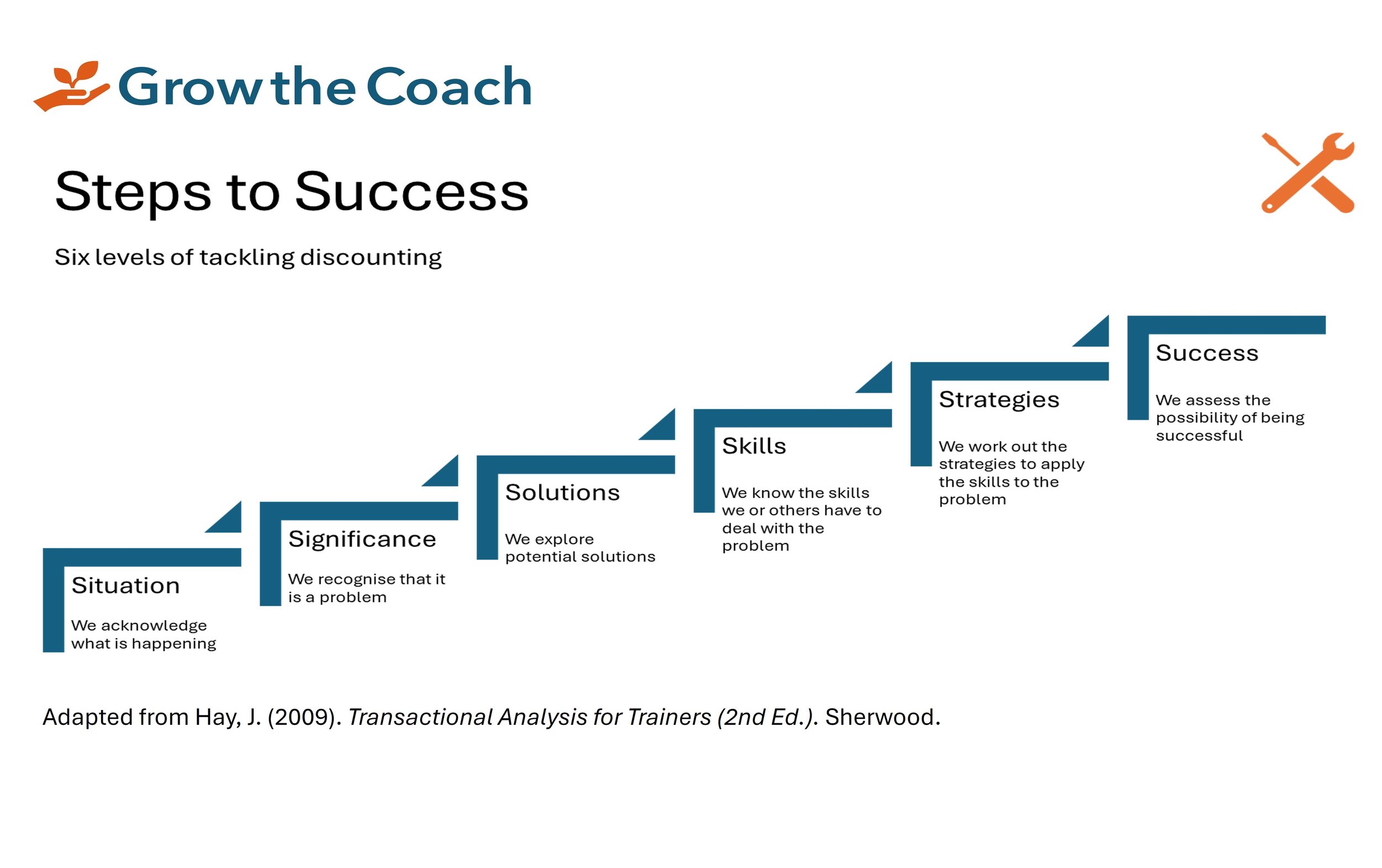
People are really good at keeping themselves stuck by playing the victim. Perhaps they are genuinely unaware of the problem or, if they recognise there is a problem, they engage in what I call BMW (bitching, moaning and whingeing – ie, they blame others for the problem and complain about it, or they either make excuses for why the problem cannot be fixed, or wait and hope that someone else will rescue them.
These are powerless behaviours. People exhibiting these behaviours keep themselves stuck by ignoring aspects of themselves, others or the situation that might help them become unstuck.
The Steps to Success model (Julie Hay, 2009) is a framework from Transactional Analysis that coaches can use with their stuck clients to help them metaphorically step up to adopt some powerful behaviours by addressing what they are discounting.
Step 1: Realise there is a problem to solve
Instead of overlooking the sign that there is a problem, encourage coachees to acknowledge reality, so that they recognise the issue and accept that something needs to be done.
Step 2: Realise the significance of the problem
Instead of overlooking the problem's importance, they recognise it is of consequence to them.
Step 3: Realise it can be solved.
Instead of adopting a position that it cannot be solved, they begin to imagine possibilities of it being solved.
Step 4: Realise that people solve problems
Instead of admitting that, while it might be solvable, surely it is not their problem to solve, they begin to recognise they have a responsibility for their role in the situation, ie, they begin to ‘own’ it.
Step 5: Realise that people need to act to solve problems
Instead of admitting there are options for others, they admit there are options for them to take themselves. They begin to think about practical solutions, actively seeking ways to resolve the issue.
Step 6: Success!
Coaches can help their clients to avoid sabotaging their efforts, so that they make positive change happen by implementing solutions.
The key for a coach is to work out where their client is starting from – are they off the bottom of the steps (powerless), or are they discounting something – existence (step 1), significance (step 2), change possibilities (steps 3 & 4), or their own ability (step 5) to make a difference?
The trick is not to try to jump steps; instead, take your time to help your client walk up the steps to success.
