
#183 Adventures in the Peculiar Kingdom of Coaching Supervision

Apologies for the rather long post this week, which celebrates the journey towards my upcoming book, The Coaching Supervision Casebook. I offer no apologies for the fun I had writing up the journey (with a little light-hearted editorial assistance from my artificially intelligent colleague).
Chapter 1: A Most Curious Expedition Into the Realm of Peer‑Reviewed Research
My tale begins in a period of professional curiosity - a kind of supervisory quandary - when I first sensed an unsettling fog around my own practice. Though I had long traversed the landscapes of coaching, I found myself unable to chart the contours of supervision with any precision. What manner of craft was I plying, and by what strange fortune was I remunerated for it? Thus began my life on the quayside, staring at maps that refused to reveal their secrets.
Then, in the late summer of ‘21, a faint breeze stirred. A small but insistent question beckoned me toward open waters: might I, like the natural philosophers of old, describe this elusive creature called supervision in practical terms? It was the whisper of adventure, though I scarcely recognised it as such.
Naturally, I resisted. I, a mere practitioner, venturing into the scholarly wilds? Preposterous. My mind filled with the familiar chorus of unworthiness. I felt like an untrained deckhand contemplating a voyage reserved for seasoned captains.
But Providence intervened. My esteemed former tutor, Emeritus Professor Bob Garvey, appeared like a pirate quartermaster offering provisions and a compass. With his encouragement, I found the courage to leave the safety of the shore.
My first steps were modest yet momentous: the opening of a research journal and the consecration of Mondays to inquiry. Each week, I set sail anew, navigating unfamiliar currents of literature, interviews and analysis.
The voyage soon presented its trials. Treacherous reefs of academic jargon threatened to wreck me. Vast archipelagos of research papers demanded charting. Yet I was buoyed by loyal companions – Bob and my research partners as fellow travellers, who kept me afloat when the waters grew rough.
As I approached the shores of my first submission, I encountered a formidable headland: the endless revising, the over‑editing, the fear that every sentence might betray my amateur status. Still, I pressed on.
Then came the storm. The peer reviewers - formidable gatekeepers of this scholarly continent - returned their verdicts. Their critiques struck like gales. For a moment, I believed the entire expedition had been folly, and that I would be cast overboard before ever setting foot on land.
Yet in that tempest, I discovered something unexpected: a voice - my own - steady and assured. I realised I could heed the scholars without surrendering my identity. I could claim my place on this map.
With renewed clarity, I revised, refined and resubmitted. And at last, acceptance came.
The final test lay not in writing but in speaking - sharing my findings with other practitioners and researchers, exposing the fruits of my journey to public scrutiny. Yet even this, in time, became a pleasure.
And now, I find myself in a new chapter of life. No longer merely a traveller, but a bona fide practitioner‑researcher. My practice is richer for the voyage, my curiosity keener and my appetite for further expeditions undiminished.
For, as any explorer knows, one successful journey only awakens the desire for the next.
Chapter 2: The Voyage Toward Authorship
No sooner had I returned from my first scholarly expedition - that perilous crossing into the world of peer‑reviewed research - than I found myself once again unsettled. Though I had published papers and spoken at length about supervision, I remained, in my own estimation, no author. I was like a naturalist who had catalogued a few curious specimens but had never yet attempted a full compendium.
For some time, the notion of case study research had hovered at the edges of my imagination, much like an unexplored island glimpsed through morning mist. Yet my understanding of such work was limited, and I could not discern where to set my first footstep. It was only during the preparation of a case study for Sage Business Cases that the fog lifted. I realised that my desire to explore supervision through lived examples might be better served not by another paper, nor by the long, arduous ascent of a PhD, but by a book. A whole volume of case studies. A chart of the territory itself!
This revelation unfurled before me like a new coastline, and in ‘24, I laid this vision before my fellow practitioner‑researchers.
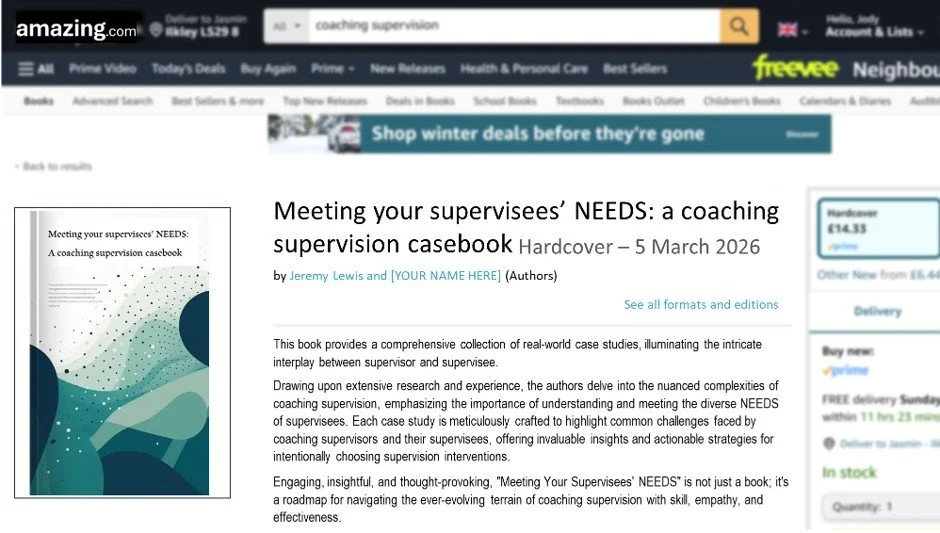
mock-up of proposed book
Yet, the vision brought with it a new predicament. Should I attempt to write every case myself, or enlist fellow travellers? And if the latter, why would any practitioner choose to embark on such a voyage with me? I felt again the familiar tremor of self‑doubt.
Yet, as before, guides appeared. Bob Garvey, Fiona Adamson and David Lane - seasoned explorers all - offered counsel, encouragement and the occasional necessary prod. With their support, I set about drafting a proposal.
An earlier rebuff from another publisher still smarted, and the prospect of approaching Routledge filled me with the same dread a sailor feels when returning to a storm‑tossed sea. To steady myself, I sought advice from published authors and gathered contributors, partly for the proposal’s second draft, partly for courage.
Almost at once, I found myself deep in the labour of assembling a first manuscript. Contributions arrive like dispatches from distant provinces; I edit, refine and attempt to weave them into a coherent atlas of supervision practice. The publisher’s editorial process proved a formidable mountain range to ascend.
Still, amidst the toil, I sensed a new voice emerging - one distinct from the tone of my research papers. More assured, more expansive, perhaps even more my own. Alongside it grew a sturdier belief in my purpose: to improve the practice of coaching supervision, both mine and others’, to contribute something of worth to this curious pro‑vocation of ours and, ultimately, to encourage more coaches to engage with the supervision frontier.
Today, I mailed an index of this tome to the publisher, which will bookmark the end of the digest. The vision hones into view like a lantern‑lit harbour revealing itself through the dusk.
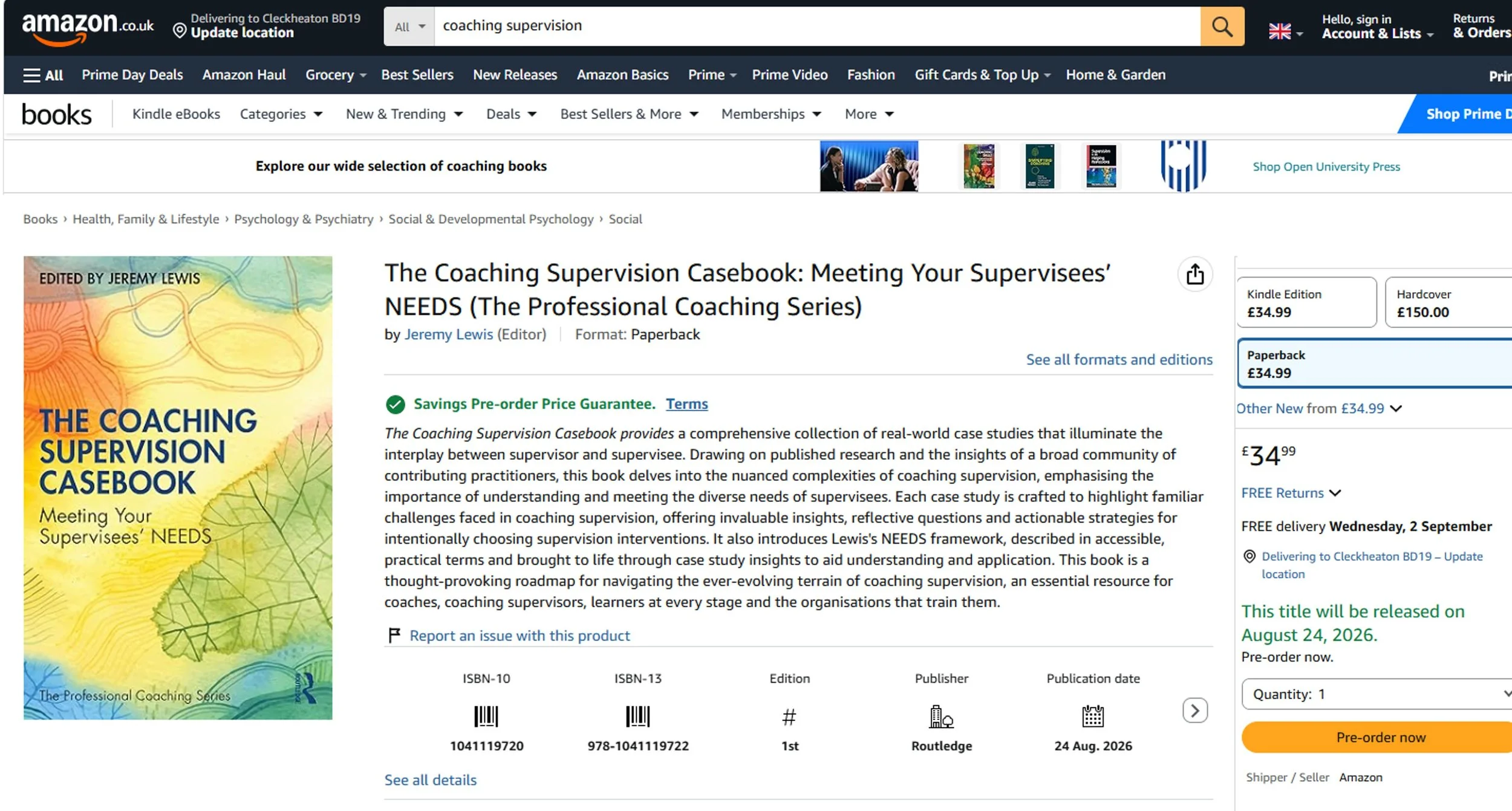
Amazon screengrab 23rd June 2026
Ahead lies the challenge of promoting the book, particularly to coaching schools - a task that feels rather like persuading distant kingdoms to adopt one’s maps. But I press on.
For I now recognise myself as an emerging voice in this field, perhaps even one with some humble authority. And should this book find its place in the world, I hope it will stand as a small legacy: a clearer understanding of supervision, a richer practice and a deeper engagement with the craft we share.
And, as with all my journeys, I suspect it will only whet my appetite for the next.
Pre-order on Amazon now.
The Coaching Supervision Casebook is also available directly from Routledge, where pre-orders will be taken from 3rd August, with a 20% discount available using code 26EFLY2.
