
#168 The structure and dynamics of coaching supervision groups
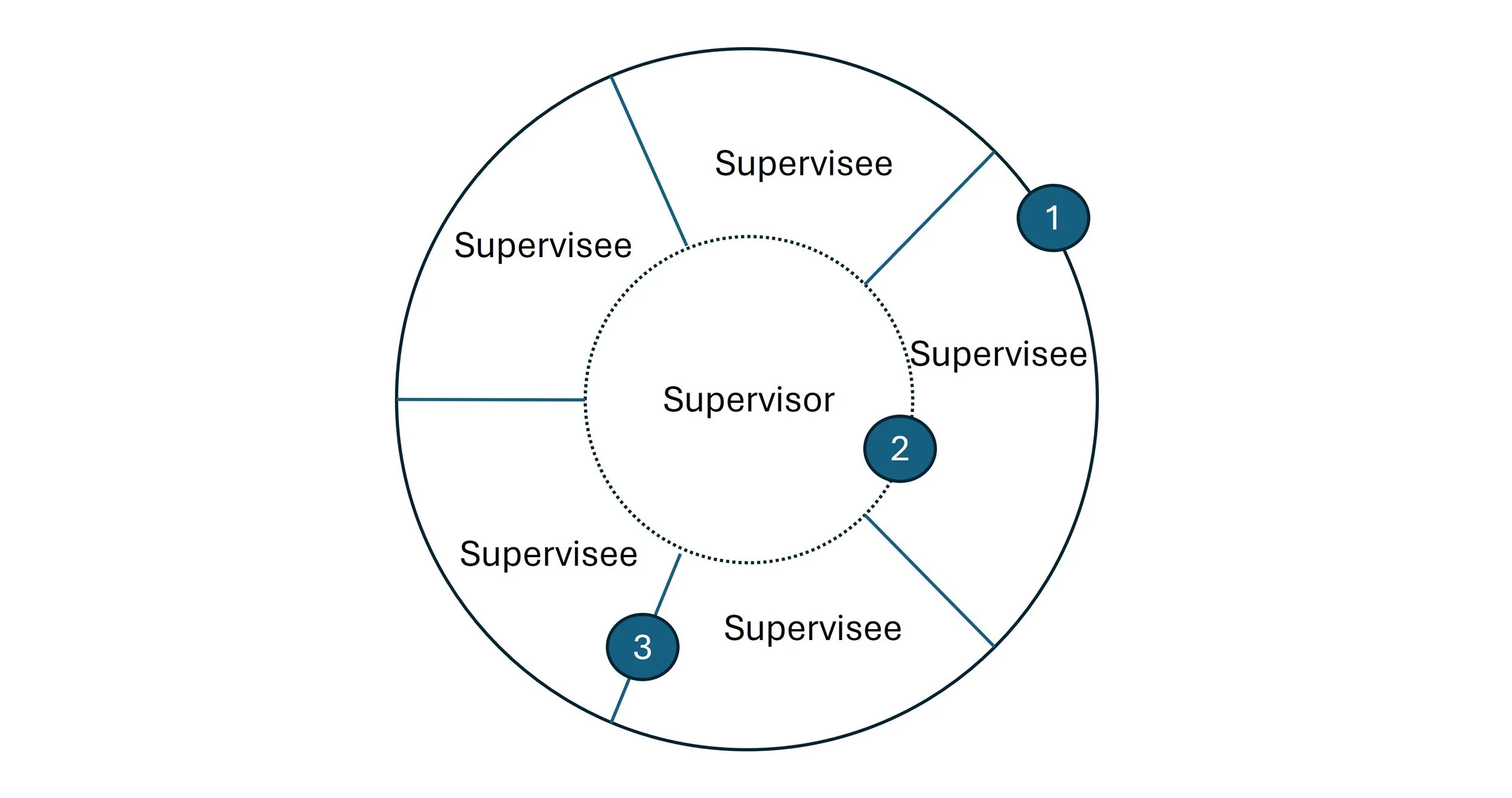
In 1963, Eric Berne wrote about the structure and dynamics of groups. I’ve been mulling over his ideas as I think about my coaching supervision groups.
I run several supervision groups. The smallest has two coaches, the largest has five. These are ‘closed’ supervision groups, meaning that they are not open to new supervisees joining. They form and then remain together for several years. Occasionally, someone might choose to leave a group, resulting in an opening for someone new to join. This happened recently in one of my groups.
This year, I am also piloting a larger group. Around 20 people signed up for the pilot, and the first session is next month. It remains to be seen how this group will evolve; however, my intention is that it might become an open supervision group, where other coaches can join the group as it progresses. Btw, all my supervision is conducted on Zoom.
Berne diagrammed groups like the picture at the top of this article. The diagram here depicts a supervision group with a supervisor and five supervisees. There are three boundaries:
1. An external boundary that delineates who is in the group, and who is not.
2. An internal boundary between the supervisor and the supervisees.
3. Further internal boundaries between the supervisees. The assumption here is that the supervisees are not a team of coaches but a collection of individual coaches who have come together to engage in supervision. Ie, this is group supervision, not supervision for a team of coaches.
1. External boundary
The external boundary can be closed (like my closed supervision groups), or open (like my intention for the larger supervision group).
The benefit of an open external boundary is that it brings stimulus for fresh perspectives to the group. However, an open external boundary also runs the risk that the supervisees do not form a coherent identity as group members.
2. Internal boundary (between supervisor and supervisees)
Different coaching supervisors treat this boundary differently. I see my role as group supervisor to maintain this boundary as open as possible. For example, in contracting, I believe it is our joint responsibility to agree on the purpose and scope of supervision, the supervisory process and the expectations of each other, including how we will establish and maintain a safe, relational space for the supervision. That said, I acknowledge I have a first-mover responsibility to ensure this happens, and I may propose a process and nature of the working alliance.
I do not believe this is any different between a smaller, closed group and a larger, open group, except that contracting would need to happen more often in an open group, specifically when new members join.
3. Internal boundary (between supervisees)
In smaller, closed groups, these boundaries are necessarily closed. Each supervisee is attending for their own development – to become a better, safer coach. They contribute to others’ learning by actively engaging with others’ supervision cases, themes and questions, but they primarily attend to their own supervision topic. We may all form strong, working bonds, but we are not a team. Group members act independently, rather than truly interdependently.
In a larger, open group, the boundaries are initially open as coaches come into the session and connect with each other. Then, we break into randomly generated subgroups. Each subgroup then discusses which supervision topic it will be exploring in supervision. Each subgroup then undertakes its group supervision, with members of the other subgroups observing – but not contributing – to it. Each subgroup follows in turn. Hence, each subgroup is necessarily closed for the duration of their session. Over time, therefore, the supervisees will in effect join several closed supervision groups.
One question remains. My curiosity is not whether I have introduced another boundary – (4) in the diagram below – clearly, I have! My curiosity is whether the boundary between the supervisees in a subgroup is open or closed. Upon initial consideration, it appears to be closed: in essence, I have created several smaller, closed groups within a larger group, albeit for a very short duration. However, because each subgroup has chosen one topic for supervision, I wonder whether the boundary between them behaves more openly. Are they still independent learners? Or have they become interdependent as they learn together with that one topic as their learning goal?
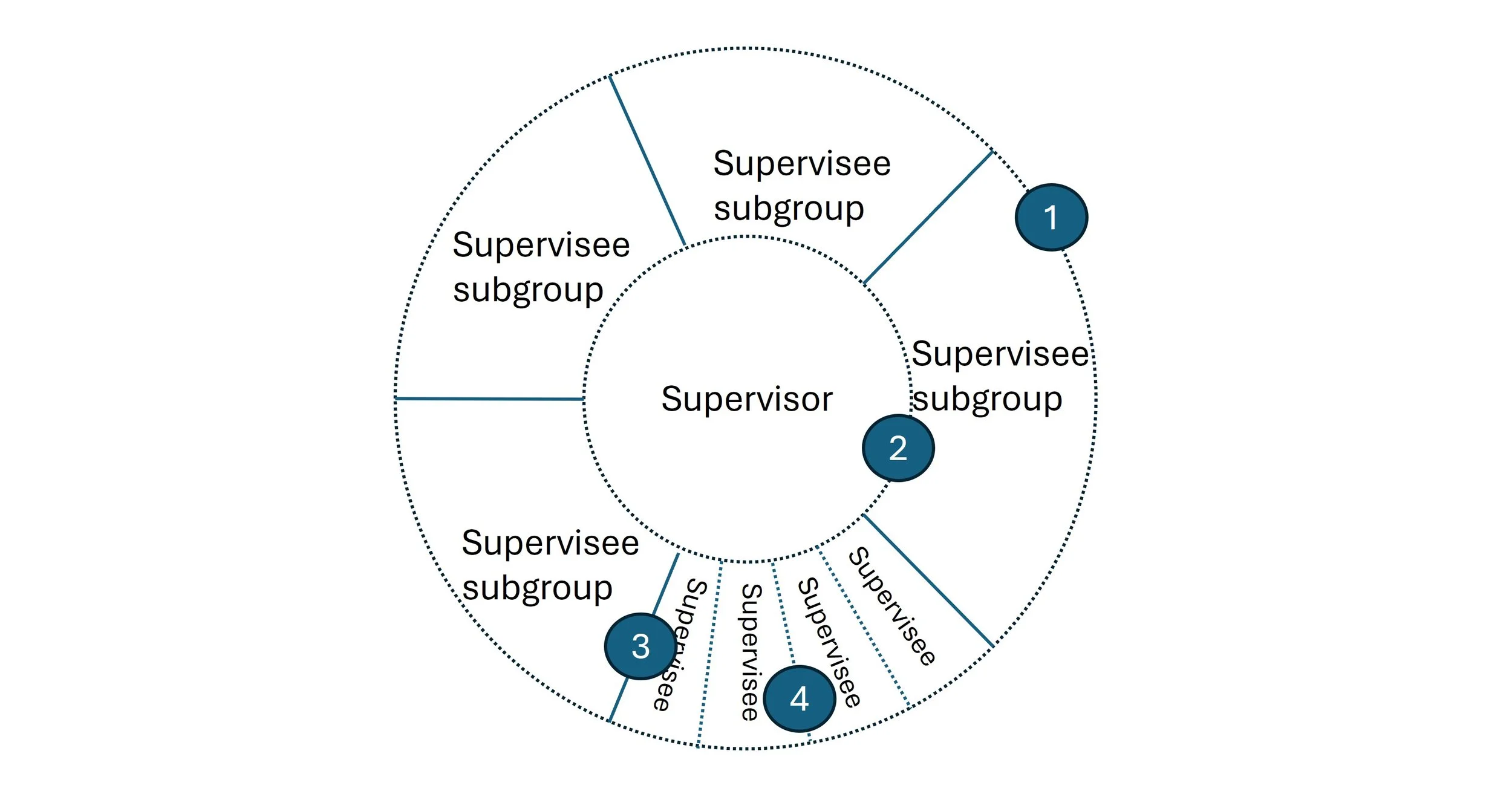
The structure and dynamics of a large, open supervision group
This isn’t merely academic reflection on my part. The answer may well have profound implications for group supervision. Because if we decide boundary (4) is more open than closed, what are the implications for boundary (3)? If we accept that mutual learning is a goal of supervision – for supervisees and their supervisor – then perhaps we should work hard to keep boundaries (2) and (3) as open as possible.
And if we do that, then why don’t we open boundary (1), too?
Hence, my pilot group.
I’ll let you know how we get on!
